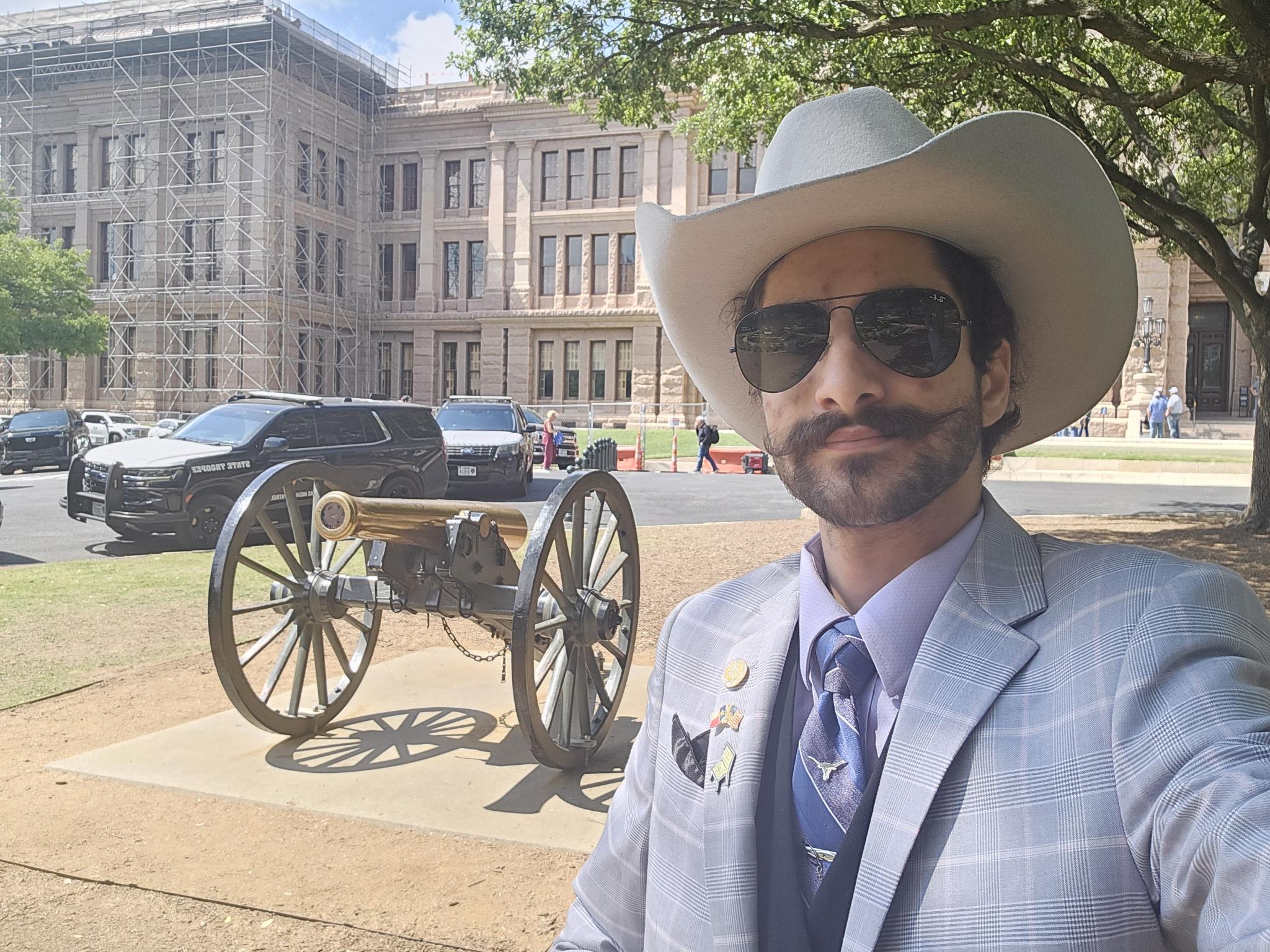
AUSTIN —
The Socialist Cowboy: Arshia Papari and the New Vanguard of Texas Activism
By Jordan Ellis
In the high-stakes theater of Austin politics, few figures have cut as distinctive a profile in recent years as Arshia Papari. Often referred to as the "Socialist Cowboy," the 22-year-old University of Texas at Austin student has spent the last two years attempting to bridge the gap between the chaotic energy of campus protest and the rigid structures of the Texas Legislature. Following a high-profile, albeit unsuccessful, bid for Texas House District 49 in 2025, Papari finds himself at a crossroads—re-evaluating his strategy while maintaining his grip on the national Green Party stage.
From the South Mall to the Ballot Box
Papari's rise to prominence was fueled by the friction of the 2024 academic year. As a second-generation Iranian-American studying Government and Middle Eastern Studies, he emerged as a fixture of the divestment movements and campus speech protests that roiled UT Austin. His visibility as a spokesperson for Gen Z frustrations wasn't just a byproduct of his activism; it became the cornerstone of his political identity.
When he entered the race for the Texas House in 2025, he did so not as a mainstream Democrat, but as a Green Party candidate running on a platform that many in the Austin establishment deemed radical. His campaign focused on:
- Economic Reform: Aggressive rent freezes and changes to Austin's urban code to protect tenants.
- Climate Justice: Rapid transitions in energy policy targeting corporate polluters.
- Civil Liberties: Enhanced protections for student activists and international residents.
The 2025 Campaign and the Reality of the Third-Party Path
The 2025 election served as a litmus test for the viability of third-party socialism in a deep-blue urban enclave. Despite garnering national attention and a flurry of small-dollar donations, Papari faced the structural hurdles typical of third-party runs in Texas. While his campaign succeeded in shifting the local dialogue—forcing opponents to address issues like the Israel-Palestine conflict and corporate influence—it did not translate into a victory at the polls.
The loss, however, did not result in the typical post-election vanishing act. Instead, it seems to have hardened the activist's resolve. His campaign was characterized by a "people over profit" ethos that resonated with a specific, energized segment of the university population, even if it failed to capture the broader district.
What Lies Ahead: A Future Beyond the Ballot
As of early 2026, Papari remains a central figure in the Green Party of the United States, currently serving as the National Co-Chair with a term extending into 2027. His future plans appear to be a hybrid of institutional leadership and continued grassroots pressure.
Observers of Texas politics suggest that Papari's likely path involves:
- Completing Academic Requirements: He remains enrolled at the University of Texas, where his presence on campus continues to inspire—and occasionally frustrate—the university administration.
- National Strategic Leadership: In his role as Green Party Co-Chair, he is expected to focus on youth recruitment and ballot access initiatives across the country, using his Texas campaign as a blueprint for other young socialist candidates.
- Local Advocacy: Without the constraints of a formal campaign, he has returned to his roots as a community organizer, focusing on tenant rights in Austin's rapidly gentrifying neighborhoods.
While the 2025 loss was a setback, it is increasingly clear that Arshia Papari does not view the legislative seat as the only metric of success. For the "Socialist Cowboy," the campaign was merely one chapter in a much longer effort to redefine what it means to be a political leader in the Lone Star State. Whether he returns to the ballot in 2028 remains to be seen, but for now, his influence continues to ripple through the steps of the Capitol and the halls of the university alike.